



How to Hire UGC Creators in the US: A Practical Process
A step-by-step process for hiring UGC creators: define the deliverables, choose a sourcing channel, shortlist and vet creators, agree terms and rights, and manage delivery.
To hire UGC creators, decide exactly which videos you need and where they will run, pick one sourcing channel (a marketplace, a managed service, a freelance site, or direct outreach), shortlist three to five creators from their sample videos, and run a small paid first project. Put deliverables, revision rounds, usage rights, and payment terms in writing before anyone films. The steps below walk through each decision in order, with a hiring checklist at the end.
This page is the end-to-end process, from "we need UGC" to approved files in your ad account. Two decisions have their own guides: which kind of platform or vendor to buy from, and how to score individual creators. They're linked where they come up.
Step 1: Define what you are hiring for
Most hiring problems start before you contact anyone. "We need some UGC" gets you quotes you can't compare and videos you can't use. Write down five things first.
| Decision | What to write down | Why it matters when hiring |
|---|---|---|
| Goal and placement | Paid social ads, organic posts, product page, email, or a mix | Placement drives usage rights, format, and price |
| Format | Talking-head testimonial, demo, unboxing, before/after, voiceover with B-roll | Creators are strong at some formats and weak at others |
| Quantity and versions | Number of finished videos, extra hooks, length cut-downs | Extra hooks and cut-downs are usually priced separately |
| Who should be on camera | Age range, setting, use case, language, accent if it matters | The viewer should recognize themselves in the creator |
| Usage and duration | Organic only or paid ads, which platforms, how long | Paid usage changes the fee and the contract |
If you're unsure what a realistic budget looks like for this scope, read how much UGC costs and what drives the price before you go further. It covers creator experience, usage, raw footage, and revisions in detail.
Start with one product and one primary angle. If you're testing several angles, hire several creators for one video each rather than one creator for many. You learn more about which messages and faces work.
Step 2: Choose where to find creators
There are four common sourcing channels. None is right for every brand. Pick based on how much time you have and how much control you want.
| Channel | How it works | Good fit when | Watch out for |
|---|---|---|---|
| UGC marketplace | Browse creator profiles or post a brief; creators apply or send offers; payment runs through the platform | You want to compare many creators quickly and keep payment protected | Platform fees, and rights terms set by the platform's terms of service |
| Managed service or agency | A team picks creators, writes scripts, and manages delivery | You have budget but no time to manage creators | Less say over who is cast; higher cost per video |
| Freelance sites | Hire a creator as a general freelancer | You already know what you want and can write the contract | Uneven vetting; you handle rights and quality control yourself |
| Direct outreach | Find creators on TikTok or Instagram and message them | You want a specific look or niche and have time to negotiate | No payment protection; you need your own contract and tax paperwork |
Named platforms, their published prices, and the questions to ask any vendor are in how to compare UGC platforms, marketplaces, and agencies.
Finding creators yourself on TikTok and Instagram
If you go direct, search the platforms for the phrase "UGC creator" plus your niche (for example "UGC creator skincare"), look for bios that say they make content for brands, and open the portfolio link if their bio has one. Then message only the ones whose samples already look like the video you need. A short, specific first message gets more replies than a vague one:
Hi [NAME], I'm [YOUR NAME] from [BRAND]. We make [PRODUCT IN ONE LINE].
I liked your [SPECIFIC VIDEO / FORMAT] - that's close to what we need.

The project: [N] vertical video(s), [LENGTH] seconds, [FORMAT],
for [ORGANIC / PAID ADS on PLATFORMS] for [TERM].
We ship the product; filming window [DATES].

Are you available, and what would you charge for this scope,
including [N] extra hooks and [RAW FOOTAGE YES/NO]?
Happy to send the full brief.
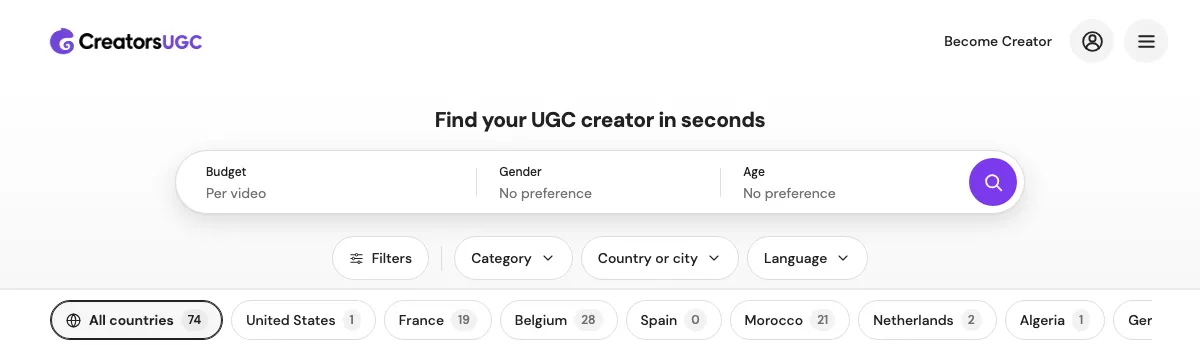
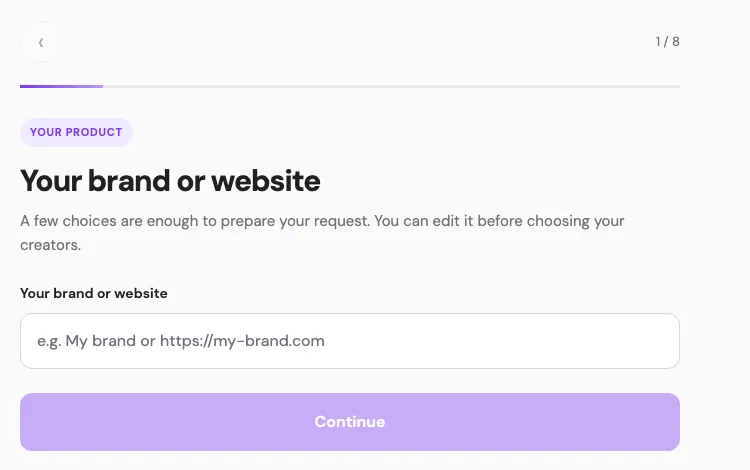
On CreatorsUGC (our platform), you can browse creator profiles that show sample videos, rates, and reviews, or post a free brief and receive offers from creators. Payment is by card through Stripe and is held until you approve the delivery. Our US creator network is new, so expect a smaller US selection than on established US platforms.
Step 3: Write the brief before you shortlist
Write the brief before you shortlist, even if you plan to message creators directly. The brief is what you'll judge applicants against, and it gives every creator the same information so their quotes are comparable.
A usable brief covers the product, the target viewer, the single main message, must-say and must-avoid claims, the format and length, the deliverables, the deadline, and the usage rights. Our UGC brief template has every section ready to copy, with a filled-in example.
Under the FTC's Endorsement Guides, advertisers are liable for misleading or unsubstantiated statements made through endorsements (16 CFR 255.1(d)). If a creator says your supplement "fixed my sleep," that is your claim. List approved and banned claims in the brief, and don't ask a creator to say something you couldn't legally say yourself.
Step 4: Shortlist and vet creators
Aim for three to five finalists for each video you need. Judge the sample videos, not follower counts: in UGC you're paying for the content, which usually runs on your accounts and ads, not for the creator's audience.
Look at the first three seconds of each sample (would it stop a scroll?), audio clarity, how the creator handles a product on camera, and whether their past work looks like it followed a brief. Our portfolio scorecard turns this into a weighted score with red flags and a paid test task, so you can compare finalists fairly instead of going on gut feel.
Before you commit, also check:
- The creator can actually use your product. The FTC's rules say that when an ad represents that the endorser uses the product, they must have been a bona fide user of it when they gave the endorsement (16 CFR 255.1(c)). Ship the product early enough for real use, not just an unboxing.
- They can meet your deadline, including time for shipping and one revision round.
- Their reviews or references mention delivering on time and following feedback.
- They have no conflicting exclusivity with a direct competitor, if that matters to you.
Step 5: Agree terms and usage rights in writing
Before filming starts, both sides should agree on the following. A marketplace's terms may cover some of it; direct hires need it all in a written agreement.
| Term | What to specify |
|---|---|
| Deliverables | Number of videos, length, aspect ratio (usually 9:16), hooks or variations, captions or no captions, raw footage yes or no |
| Revisions | How many rounds, what counts as a revision versus a new brief, turnaround for revisions |
| Timeline | Product arrival date, draft date, final date |
| Usage rights | Organic vs. paid, platforms, duration, territory, whether ads can run from the creator's handle |
| Payment | Amount, currency, when it is released, what happens if delivery is late or rejected |
| Product | Whether the creator keeps it, and whether shipping is reimbursed |
Usage rights deserve their own read. Who owns a video and what you're allowed to do with it depends on the contract. Under US copyright law, freelance work is a "work made for hire" only in specific circumstances that require a signed written agreement, according to the U.S. Copyright Office, so you shouldn't assume you own everything you paid for. UGC usage rights for brands explains organic vs. paid licenses, whitelisting, and how to word the terms.
Paperwork when you pay US creators directly
If you hire a creator outside a platform, they are normally an independent contractor, not an employee. The IRS decides worker status on behavioral control, financial control, and the type of relationship, and it says no single factor decides it. For a US creator, collect a Form W-9 so you have their taxpayer ID. For a creator outside the US, the IRS says a foreign person gives Form W-8BEN to the payer when the payer requests it. The IRS instructions for Form 1099-NEC set the reporting threshold for nonemployee compensation at $2,000 for payments after 2025, and they say payments made by credit card or through third-party payment networks are reported on Form 1099-K by the payment processor, not on Form 1099-NEC. This is general information, not tax advice. Confirm your own filing obligations with a tax professional.
Step 6: Brief, ship, and manage the production
- Kick off in writing. Send the final brief, confirm the deadline, and ask the creator to restate the main message in their own words. If they get it wrong, you've caught a problem before filming instead of after.
- Ship the product with tracking. Include anything the creator needs to show it properly: instructions, the right shade or size, a second unit if a demo could break it.
- Ask for a script or outline first for anything that makes claims or needs a specific structure. It's quicker to fix a script than a finished video.
- Answer questions fast. Most delays come from a creator waiting on a reply about something the brief didn't cover.
Step 7: Review, request revisions, and approve
Review against the brief, not your personal taste. Ask three questions: Did it say the main message? Did it avoid banned claims? Is it technically usable (framing, audio, length, file format)? If any answer is no, that's a fair revision request. Wanting a different hook after you approved the script is a new request, so expect to pay for it.
Write revision notes with timestamps and specifics. For example: "0:03 to 0:06, please say 'fragrance-free' instead of 'unscented'; 0:12, the label is out of frame." Bundle all notes into one message per round.
Once you approve, release payment promptly, download the files and store them with the agreement attached, and log the usage terms somewhere your media buyer will see them. A video that runs past its licensed period is a contract problem.
Note which creators were easy to work with and whose videos performed. A short list of reliable repeat creators is worth more than a long list of strangers. For running this as a monthly program, see planning ongoing UGC and creator retainers.
Hiring checklist
- Goal, placement, format, quantity, and usage written down
- Budget checked against the scope, including paid usage and extras
- Sourcing channel chosen
- Brief written with approved and banned claims
- Three to five finalists scored on their sample videos
- Deliverables, revisions, timeline, usage rights, and payment agreed in writing
- W-9 (US) or W-8BEN (non-US) collected if paying a creator directly
- Product shipped with enough time for genuine use
- Script or outline approved for claim-heavy videos
- Delivery reviewed against the brief; revisions sent in one batch
- Files and license terms stored together
FAQ
Do UGC creators need followers?
No. You're buying the video, which you post or run as an ad from your own accounts. Follower count matters for influencer marketing, where you pay for the creator's audience. See UGC vs. influencer marketing for the full comparison.
How much does it cost to hire a UGC creator?
Creators set their own rates, and the total depends on usage rights, extra hooks, raw footage, and platform fees. Some platforms publish prices; how much UGC costs lists them with a budget worksheet.
How long does hiring take?
It depends on shipping, the creator's schedule, and how fast you give feedback. Plan the timeline backward from your launch date and agree on draft and final dates with each creator in writing. The first campaign plan has a week-by-week example.
How many creators should I hire for a first test?
Enough to compare more than one face and angle. Several creators making one video each tells you more than one creator making several. The right number depends on your budget and on how many ad variations your account can test at once.
Should I pay a creator for a test video?
Yes. Asking for free "test" content is a red flag to good creators and gets you weaker applicants. A small paid first project is the test.
Do I need a contract if I use a marketplace?
Read the platform's terms of service first. They often set the default usage rights and payment rules. Anything you need beyond those defaults, such as longer paid usage, TV, or exclusivity, should be agreed in writing with the creator.
Sources
- 16 CFR § 255.1 — General considerations (Endorsement Guides) — Legal Information Institute, Cornell Law School
- FTC's Endorsement Guides: What People Are Asking — Federal Trade Commission
- Circular 30: Works Made for Hire — U.S. Copyright Office
- Independent contractor (self-employed) or employee? — Internal Revenue Service
- About Form W-9 — Internal Revenue Service
- About Form W-8 BEN — Internal Revenue Service
- Instructions for Forms 1099-MISC and 1099-NEC — Internal Revenue Service
CreatorsUGC publishes this guide. We run a UGC marketplace, so we have an interest in the topic — we link to independent sources for facts and label illustrative examples.